Arguments & Reconciliation
Conflicts are a part of life. They are important learning areas for social competence. With humanistic values, we guide children to maintain their own boundaries, respect those of others, and peacefully come together again after a storm.
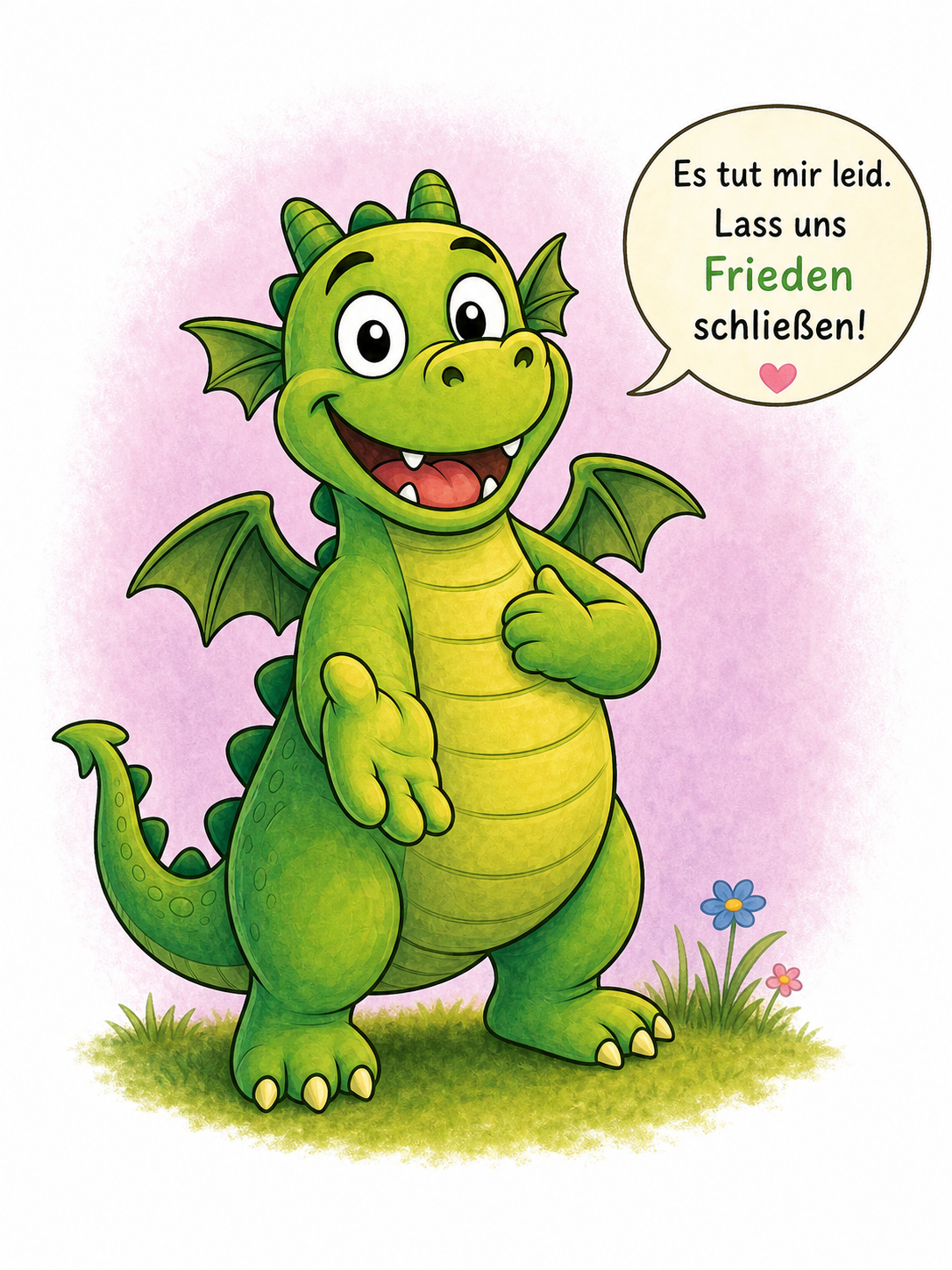
1. Learning to name feelings
Help your child find words for their feelings. 'You look very angry' or 'Are you sad because the tower fell over?' Validation calms the nervous system. For neurodivergent children, feeling cards or colors (like Spuki's green scales glowing red when angry) can help when words are difficult.
2. Anger is allowed, hurtful behavior is not
All feelings are okay, but not all actions. Set clear, calm boundaries: 'You are allowed to be angry, but I won't let you hit.' Offer safe alternatives: punching a pillow, stomping hard on the floor, or roaring loudly like a dragon from Mount Pilatus.
3. Agree on a clear stop signal
Establish a family stop word or hand signal. When this signal is used, the conflict pauses immediately. This gives security and control back, especially to children who get easily overstimulated. Spuki uses a special dragon hand signal for this.
4. Practice perspective-taking (when everyone is calm)
Only talk about the conflict when everyone has calmed down. Ask: 'How do you think your brother felt?' Autistic children often need concrete explanations of facial expressions and body language here, without it being phrased as an accusation.
5. Apology without coercion
Do not force children to say 'I'm sorry'. A forced apology does not teach empathy. Instead, model sincere apologies yourself in everyday life. True remorse is often shown in actions, not words.
6. Making amends instead of punishment
Focus on solutions. 'The tower is broken. How can we fix this?' This strengthens self-efficacy. Punishments only create shame and fear, while making amends promotes responsibility and competence.
7. Moderate sibling disputes, don't judge
Do not act as a judge looking for a culprit. Describe neutrally what you see: 'I see two children who both want to play with the red car.' Help them negotiate a fair solution themselves.
8. Guiding friendship conflicts
Give children tools for dealing with friends. Practice in role-plays how to say 'No' or find compromises. For neurodivergent children, clear scripts ('If X happens, I can say Y') are very helpful.
9. Peace corner and quiet place
Set up a low-stimulus retreat (like Spuki's cozy cave in Mount Pilatus). This place is not a 'naughty step' for punishment, but a positive place to calm down 2013 with a heavy blanket, play dough or a cuddly toy.
10. Create reconciliation rituals
Find your own ways to reconnect after an argument. This can be a special handshake, drinking a glass of water together, or reading a favorite book. Rituals provide predictability and security.
Spuki's Peace Task
Craft a 'peace stick' or a 'talking stone' together (maybe a beautiful pebble from Lake Lucerne). When there is an argument, only the person holding the stone or stick is allowed to speak. Spuki has a smooth, green dragon stone from his cave for this!
Parent Tip
Your own calm is the key. When you stay calm during a child's big feelings, your child feels: 'I am safe'. It is perfectly fine if you need to briefly leave the room yourself to take a deep breath before guiding the conflict.
These tips were developed in collaboration with the Humanistische Schule Schweiz and Inklusion Schweiz to empower all children in their uniqueness.
These tips are for general guidance. For health questions, trust your intuition and seek professional support if needed.