
Spuki's Playground Tips
Together playing, discovering and growing – 10 tips for a relaxed and joyful time at the playground. Designed for every child.
These tips are designed to work for all children – including those who experience the world more intensely. Clear structures and predictability help everyone.
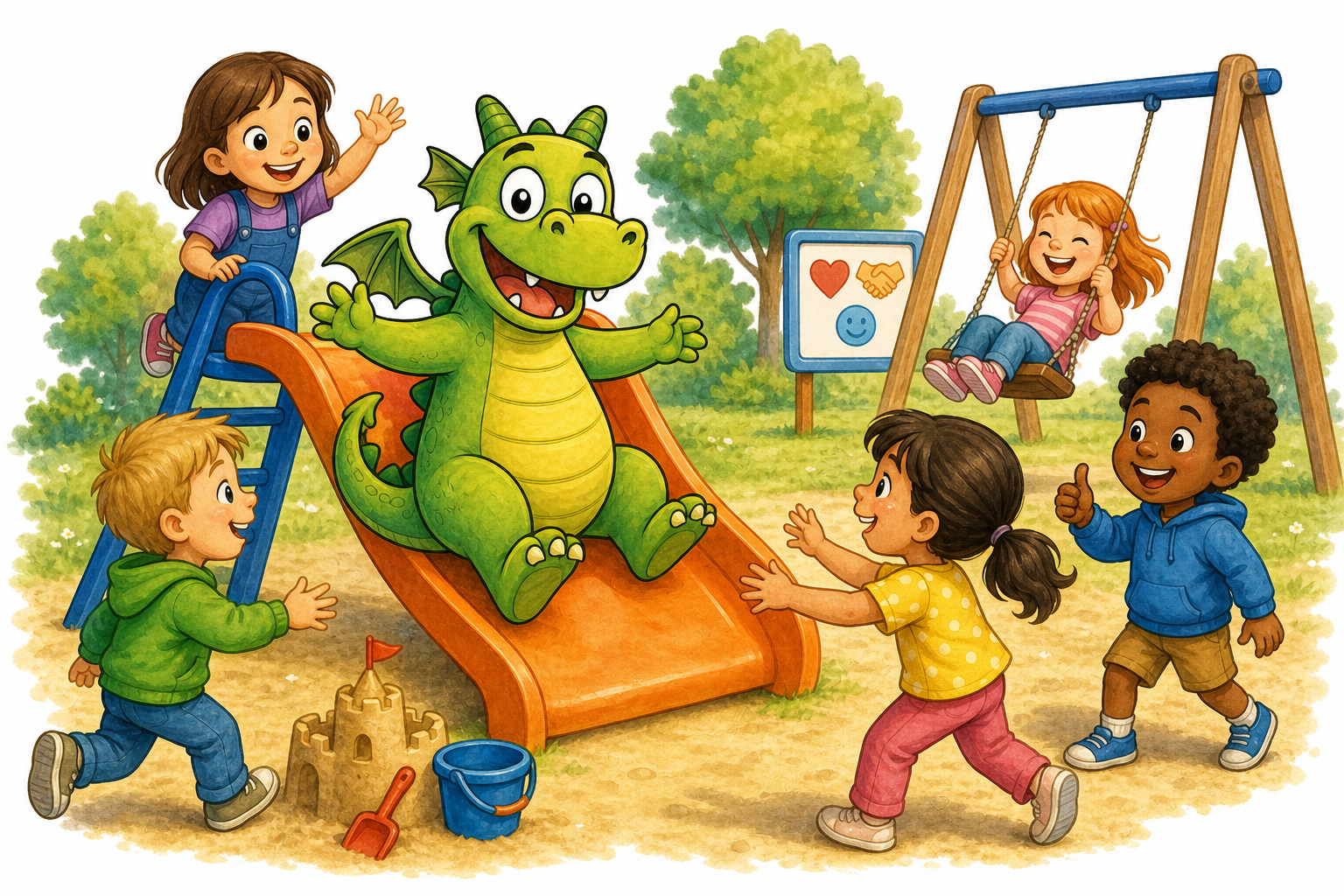
Explore the playground beforehand
Visit the playground at a quiet time first – show your child where everything is. Predictability creates security. Explain: 'Here's the slide, there's the swing, and over there is our meeting point.'
Provide clear time structure
Say beforehand how long you'll stay: 'We'll play until the church bell rings' or use a timer. Transitions are easier when they're predictable. Announce the end 10 and 5 minutes in advance.
Set up a retreat spot
Show your child a quiet spot nearby – a bench, a tree, a corner. 'If everything gets too much, you can come here. I'm here.' Retreat isn't failure, it's self-care.
Notice and reduce sensory input
Playgrounds can be loud and chaotic. Ear protection (earmuffs or earplugs) isn't weakness – it's a tool. Watch your child: hands over ears, squinting or withdrawal are signs of sensory overload.
Prepare social situations
Practice at home how to ask: 'Can I play too?' or 'Can I have the swing when you're done?' Role-playing reduces anxiety. Not every child needs to play with others – parallel play is also valuable.
Accompany conflicts, don't solve them
When conflict arises: Don't intervene immediately, but be present. Name feelings: 'You're angry because you want to swing too.' Help your child find their own solutions. Every conflict is a learning opportunity.
Respect their own pace
Some children observe for 20 minutes before joining in. That's not shyness – it's information processing. Don't push. 'You can play when you're ready. I'll wait here.'
Celebrate successes – even small ones
'You smiled at another child – great!' or 'You went down the slide all by yourself!' Every step counts. Never compare with other children. Your child is exactly right as they are.
Watch for overwhelm
Signs of overwhelm: frantic running, sudden crying, aggression, freezing or flight behaviour. React calmly without blame: 'I can see it's too much. Come, let's go to our quiet spot.'
Practice gratitude
On the way home: 'What was the best part today?' This simple question shifts focus to the positive and creates a beautiful ritual. Even if the day was difficult – there's always something good to find.
Wenn alles zu viel wird
Every child shows overwhelm differently. Here are signs to watch for:
- Hands over ears, squinting or looking away
- Sudden withdrawal or hiding
- Increased restlessness or frantic movement
- Sudden aggression or crying without obvious cause
- Freezing, not responding to being spoken to
- Repetitive movements (rocking, hand-flapping) 2013 this helps the child calm down, not a sign of misbehaviour
Important: These are not 'bad behaviour'. They are communication. Your child is telling you something.
Spuki's Task
Before you go to the playground, draw a map together! Where is the slide? Where is the swing? Where is your quiet spot? And where is the meeting point? This way, you both know exactly where everything is.
Tip: You can laminate the map and take it with you!
Tip for Parents
You don't have to be the perfect parent. If your child has a big emotional moment at the playground – that's okay. It doesn't mean you failed. It means your child reached their limit. Take a deep breath, be present, and know: this too shall pass. Other parents' looks say more about them than about you.
These tips were developed in collaboration with the Humanistic School Switzerland and Inklusion Schweiz. Our approach: What works for neurodivergent children works for all children.
More adventures with Spuki
Discover Spuki's books – stories about courage, friendship and learning.