
Feng Shui for Children's Rooms
How energy flows in a room affects how children feel, sleep, and learn. 10 principles for a harmonious children's room – especially valuable for sensitive and neurodivergent children.
1. The Bed Position – Command Position
Place the bed so the child can see the door but isn't directly in line with it. Head against a solid wall (not under a window). This gives a subconscious sense of safety – especially important for children who need security.
2. Chi Flow – Keep Paths Clear
Energy (Chi) needs to flow freely. No clutter behind doors, clear pathways between furniture, nothing blocking the window. For sensitive children: a clear room = a clear mind. Chaos in the room often mirrors inner overwhelm.
3. Colours – Calm Tones for the Sleeping Area
Sleeping area: soft blues, greens, lavender (Yin energy = calm). Play area: warm yellows, soft oranges (Yang energy = activity). Avoid bright red in the bedroom – it overstimulates. Natural earth tones ground sensitive children.
4. Five Elements – Balance in the Room
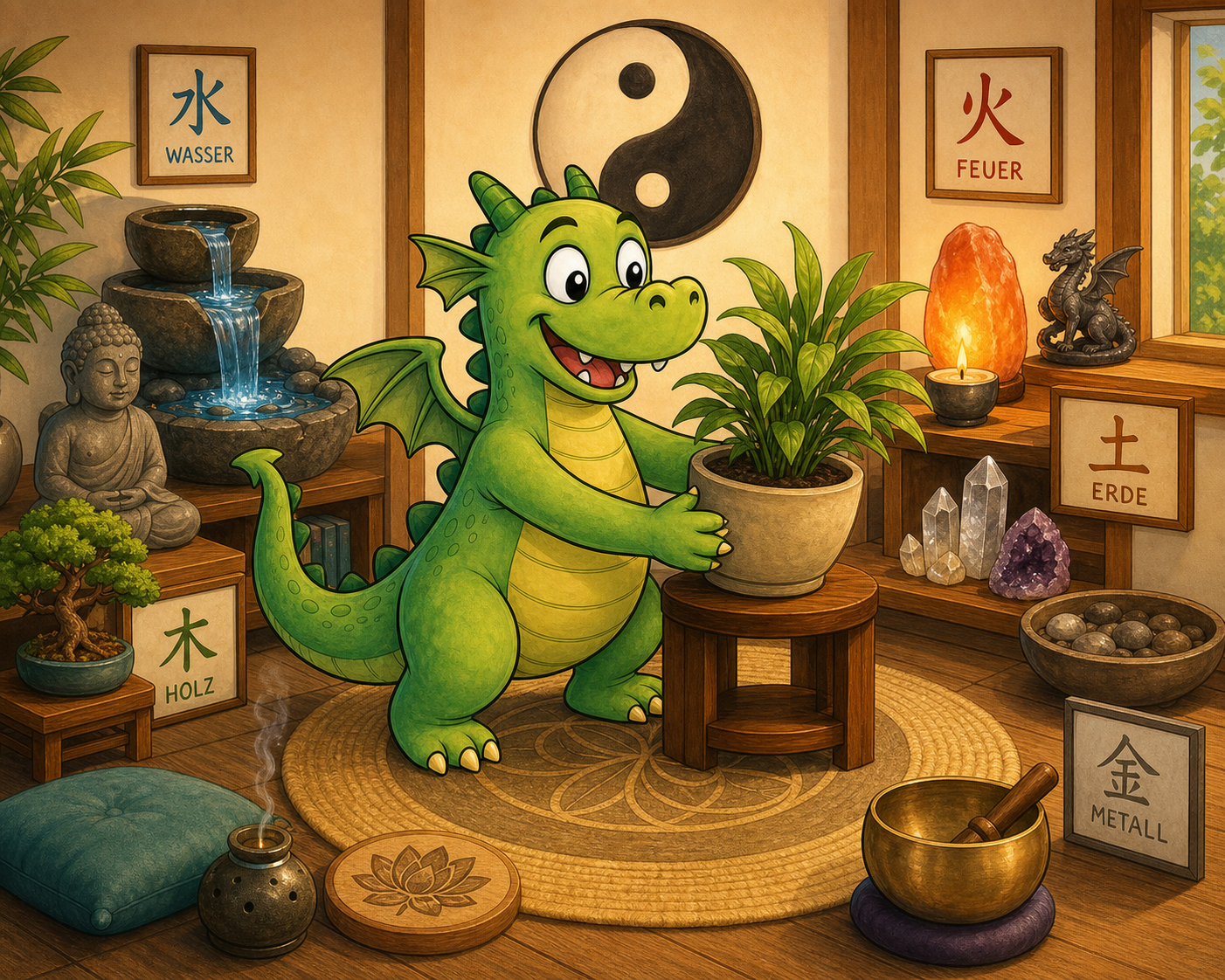
Wood (plants, green), Fire (candles, red accents, triangles), Earth (stones, ceramics, yellow/brown), Metal (round shapes, white, bells), Water (blue, mirrors, flowing shapes). Each element should be present – a room with all five feels naturally harmonious.
5. The Retreat Corner – Safe Haven
Every child needs a protected corner: a canopy, a reading nook with cushions, a tent. Place it in the 'Knowledge' area (left rear corner from the door). This is the child's sovereign space – no one enters without permission. Essential for overstimulated children.
6. Natural Materials Only
Wood, cotton, linen, wool, stone, beeswax. Avoid plastic, synthetic fabrics, and particle board (outgasses formaldehyde). Natural materials have their own energy and don't disturb the room's Chi. Wooden toys over plastic, cotton bedding over polyester.
7. Lighting – Layers of Light
No harsh overhead light alone. Create layers: soft main light, warm reading lamp, salt lamp or beeswax candle for evening. Dimmer switches allow the child to control stimulation. Blue light (screens) blocks melatonin – use warm light after sunset.
8. Crystals & Protective Stones
Amethyst by the bed (calm sleep), Rose Quartz in the retreat corner (love, comfort), Black Tourmaline by electronics (absorbs electromagnetic energy), Citrine on the desk (concentration, joy). Let children choose their own stones intuitively.
9. Declutter Regularly – Less is More
Broken toys hold stagnant energy. Rotate toys (store half, swap monthly). At waning moon: let go of what no longer serves. Involve the child: 'What makes you happy? What can we pass on?' A clear room supports clear thinking.
10. The Intention – Room Blessing
After arranging: bless the room. Light a beeswax candle, smudge with sage or lavender, speak an intention: 'This room is a place of safety, love, and growth.' Children can participate – their intention is the most powerful. Repeat at each new moon.
The Bagua Map – Room Zones
Stand at the door looking in. The room divides into 9 zones:
Wealth
Purple, abundance
Fame
Red, recognition
Love
Pink, relationships
Family
Green, health
Centre
Yellow, balance
Children
White, creativity
Knowledge
Blue, learning
Career
Black, life path
Helpers
Grey, support
↑ Back wall (furthest from door) · ↓ Door wall (entrance)
Tip for Parents
You don't need to redesign the entire room at once. Start with one principle – perhaps the bed position or decluttering. Observe how your child reacts. Children often feel the difference immediately, even without understanding why. Trust their feedback: 'I sleep better now' or 'My room feels nicer' are the best confirmations.
These tips combine traditional Feng Shui wisdom with modern knowledge about neurodivergent children's needs. Developed in collaboration with the Humanistic School Switzerland.
These tips are for general guidance. For health questions, trust your intuition and seek professional support if needed.