Fear & Courage
Understanding fears, building courage, and lovingly guiding children.
1. Fear as a normal feeling
Fear is an important feeling that protects us. Show your child that everyone gets scared sometimes – even adults and even Spuki, the dragon from Mount Pilatus. Validate the feeling: 'I see that you are scared. That is okay.'
2. Allowing to name fear
Help your child find words for their fear. A 'fear thermometer' from 1 to 10 can especially help neurodivergent children communicate the intensity without having to find many words.
3. Courage in small steps
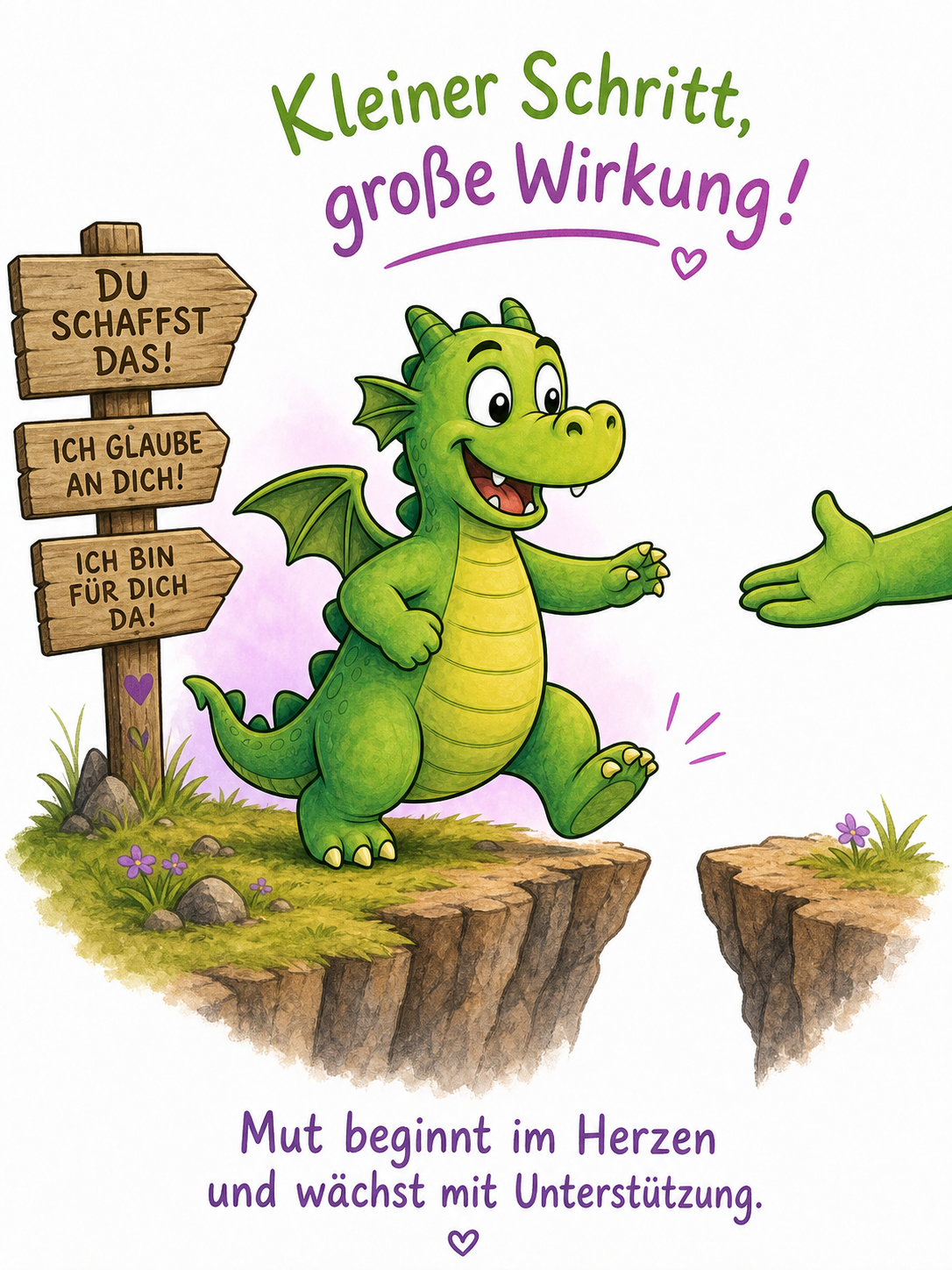
Break anxiety-inducing situations into tiny, manageable steps. Celebrate every progress, no matter how small. The child's own pace is crucial – do not push, but guide patiently.
4. Using safety anchors
A familiar cuddly toy, a smooth stone in the pocket, or a specific ritual provide safety. Such anchors are especially important in overstimulating or new situations.
5. Darkness and monsters
Take magical fears seriously. A 'monster spray' (water with lavender scent) or a small night light can work wonders. Spuki watches out at night as an invisible guardian outside the window.
6. Gently guiding separation anxiety
Create reliable farewell rituals. A drawn heart on the child's and parent's hand connects even across distance. Clear, visual time indications (e.g., 'After afternoon snack I will pick you up') create predictability.
7. Preparing for new situations
Discuss new routines in detail in advance. Photos of the new place or a 'Social Story' (a short story about what will happen) drastically reduce uncertainty.
8. Explaining physical reactions
Explain what happens in the body: 'Your heart is beating fast because your body is getting ready to protect you.' This takes away the fear of the fear. Deep breaths (snorting like a dragon) help calm down again.
9. The courage diary
Collect moments when the child was brave. A courage diary (drawn or written) serves as proof of their own self-efficacy when fear seems big again.
10. Spuki's courage spell
Practice an empowering phrase. For example: 'I am strong like the Pilatus dragon and I can do this!' Such mantras provide inner support in difficult moments.
Spuki's courage task for you
Make your own courage stone! Find a nice, smooth stone outside. Paint it green, like Spuki. The next time you feel a little scared, put the stone in your pocket. Hold it tight and feel Spuki's dragon courage flowing into you.
Tip for parents
Your own calmness is contagious. When your child is scared, try to take a deep breath yourself and act as a safe haven. When you stay calm, your child feels it too. Finding peace together is the first step. It is not about making the fear go away immediately, but about enduring it together.
Spuki's Courage Affirmations
Words have power. Children can say these sentences to themselves – aloud or quietly, in the morning before the mirror or in bed at night. They strengthen inner trust:
I am brave, even when I feel afraid.
My body is strong and protects me.
I may feel fear – it will pass.
Inside me shines a light that never goes out.
I am exactly right, just as I am.
I trust myself and my path.
Tip: Write the favourite affirmation on a stone or card. This way your child can carry it in their pocket anytime.
These tips were developed in collaboration with the Humanistische Schule Schweiz and Inklusion Schweiz to strengthen all children in their uniqueness.
These tips are for general guidance. For health questions, trust your intuition and seek professional support if needed.