Values that last. Knowledge that brings joy.
Spuki's World is a pedagogically grounded children's universe: core values like courage, compassion and respect, wrapped in stories, anchored in the Swiss curriculum (Lehrplan 21).
Spuki's family tips
Practical tips for family life
Clear ideas for the pool, playground, nature and more – for relaxed time together.
Why Stories Work
Why stories are the most effective way to teach children values – and how the Spuki books put these findings into practice.
22×
better remembered
Information embedded in stories is remembered up to 22 times better than plain facts – according to organisational psychologist Peg Neuhauser (Harvard Business Review).
Cognitive Development
Neuroscientific studies show that when listening to a story, the brain activates far more than just the language centres – motor skills, emotions and sensory processing all engage too. The brain literally experiences the story. Children who are read to regularly show up to 30% better cognitive abilities than their peers in studies.
Source: Harvard Business Review / Neuhauser, 2015Emotional Intelligence
By identifying with characters like Spuki, children learn to recognise, name and regulate emotions. When a child experiences how Spuki overcomes his fear, it activates the same neural patterns as a real experience. This helps children develop empathic skills and emotional resilience – in a safe, playful way. Research shows: children with high emotional intelligence are more successful in relationships and careers later in life.
Source: Herder Verlag / Kita-Forschung, 2020Values Through Narratives
Psychologist Jerome Bruner showed that people understand the world primarily through stories, not abstract rules. Children adopt behaviours and values from characters they identify with – without being lectured. This 'value transmission through stories' is 22 times more effective than pure fact-sharing, because it works on an emotional level and anchors in long-term memory.
Source: Jerome Bruner / Narrative Research, 1991Language Development & Literacy
Regular reading aloud expands a child's vocabulary by up to 50% compared to children who are not read to. Stories also promote narrative competence – the ability to structure and tell one's own experiences. These skills are the foundation for later reading and writing abilities and academic success.
Source: Kindergartenakademie / Sprachförderung, 2022How It Works in Practice
Recognise
Children see themselves in Spuki – he's funny, sometimes insecure, has a rough edge. This emotional connection is the key: those who recognise themselves open up to learning.
Experience
Through the adventure, children experience how Spuki works on himself – not through lecturing, but through action. The brain barely distinguishes between lived and narrated experience.
Grow
At the end of every story, Spuki has learned something. Children feel this – and take it into their own everyday life. What they feel, they don't forget easily.
Frequently Asked Questions
Our Approach
Children don't learn values through lecturing, but through stories and role models. In Spuki's world, values are not a moral at the end, but the 'natural law' of the world itself: the Dragon Stone glows through good deeds, crystals grow through learning, and access to the valley opens through kindness. When the characters build something together – a bridge, a treehouse – they need tools: a spirit level so everyone stands at the same height, a set square so it's fair. This way, children experience courage, helpfulness, gratitude and respect as something that works – not something they must do.
Anchored in the Swiss Curriculum (Lehrplan 21)
| Value Family | Cross-curricular Competence (LP 21) | Learning Moments |
|---|---|---|
| Courage Builders | Personal skills: independence, dealing with failure | Courage, self-confidence, resilience |
| Heart Helpers | Social skills: cooperation, conflict resolution, empathy | Friendship, helpfulness, humanity |
| Knowledge Seekers | Methodological skills: using information, solving problems | Counting, letters, geography of Switzerland |
| Nature Guardians | Personal & social skills: responsibility, sustainability | Botany, gratitude, respect |
Courage Builders
Personal skills: independence, dealing with failure
Courage, self-confidence, resilience
Heart Helpers
Social skills: cooperation, conflict resolution, empathy
Friendship, helpfulness, humanity
Knowledge Seekers
Methodological skills: using information, solving problems
Counting, letters, geography of Switzerland
Nature Guardians
Personal & social skills: responsibility, sustainability
Botany, gratitude, respect
The Books
Each Spuki book comprises at least 20 lovingly illustrated pages in watercolour comic style. All speech bubbles are written as four-line rhymes – promoting language rhythm and memorability. The yellow learning box at the bottom of each page translates the experience into a small task: counting, spelling, discovering. Places like the Chapel Bridge, Lake Lucerne and Mount Pilatus are depicted realistically, so families can actually visit the settings.
Rooted in Real Swiss Legend
Spuki's world builds on the over 600-year-old Lucerne dragon tradition: in 1421, a dragon is said to have dropped the famous Dragon Stone near Mount Pilatus – it is still exhibited in the Nature Museum Lucerne today. The old legends describe the Pilatus dragons as good-natured, helpful beings. This authentic anchoring distinguishes Spuki's world from purely invented fantasy worlds and creates real excursion and learning opportunities.
Why reading aloud is the most beautiful gift
Whether parents, grandparents, godparents, aunts or uncles – everyone who reads to a child gives them something priceless: time, closeness and the foundation for a fulfilled life. Here you'll learn why reading aloud is so much more than just telling stories.
Strengthening bonds
Reading aloud creates closeness and comfort. The shared time with a book is a gift that children carry with them for a lifetime. Whether mum, dad, grandma, grandpa or godparent – every story read aloud strengthens the relationship.
Promoting language
Children who are read to regularly have up to 50% larger vocabularies. They learn complex sentence structures, develop a feel for language and are more successful in school later.
Providing security
In a world full of stimuli and change, stories offer a safe harbour. Rituals like reading before bedtime give children structure, reliability and the feeling: I am safe here.
Passing on values
Grandparents and relatives can share their life experience through stories. When grandma or grandpa reads aloud, a cross-generational knowledge transfer takes place – playfully, lovingly and unforgettably.
Unfolding imagination
When reading aloud, images form in the mind – much more vivid than any screen. Children develop creativity, imagination and the ability to tell their own stories and solve problems creatively.
Giving quality time
In our hectic everyday life, reading aloud is a conscious choice for shared time. Just 15 minutes a day make an enormous difference – for the child's development and for the relationship.
Spuki explains: Why stories help children
A brief insight into the world of narrative learning with Spuki
Spuki says: "Every child deserves someone who reads to them!"
Studies show: children who are read to for just 15 minutes a day have a decisive advantage – in language, social behaviour and emotional well-being. The best part? No special training is needed. Just a book, a child and an open heart.
Find the perfect read-aloud bookHow to read Spuki aloud best
Simple tricks that make reading aloud more lively – for both of you. No effort, big impact.
Change voices
Give Spuki a deep, funny voice and each of his friends their own. Children love it when characters come alive – and it helps them follow the story better.
Take pauses
Pause at exciting moments and ask: ‘What do you think happens next?’ This encourages thinking along and turns reading aloud into a shared experience.
Let them describe pictures
Let your child describe the pictures before you read. ‘What do you see on this page?’ This strengthens vocabulary and observation skills – without any pressure.
Name emotions
Point to Spuki’s face and ask: ‘How is Spuki feeling right now?’ Children learn to recognise and name feelings – an important foundation for empathy.
Allow repetition
If your child wants to hear the same book for the tenth time – wonderful! Repetition provides security and deepens understanding. Each time, children discover something new.
Discover the learning box together
The yellow learning box at the bottom of each page is not a test. Explore it together when your child feels like it. Count together, look for letters or talk about the value – playfully and without expectation.
The most important thing: there is no ‘right’ or ‘wrong’ when reading aloud. The main thing is that you have a good time together.
Kevin Huber
Father and storyteller – with a mission that comes from real life.

A story that comes from real life
Kevin Huber is the father of an autistic son. This experience has fundamentally changed his life and his view of education. He knows first-hand how challenging it can be to find the right way for a child to learn with focus – and how frustrating it is when traditional methods don't work.
What drove Kevin most was a deeply human wish: to accompany his son on the path to an independent, everyday life. A life where his uniqueness doesn't take centre stage – but rather his strengths, his curiosity and his very own way of seeing the world.
But Kevin discovered something crucial: when children learn through stories and motifs, a whole new world opens up for them. His son, who struggled with conventional learning methods, suddenly blossomed when he could absorb knowledge through narratives and pictures. This experience became the foundation of the Spuki books.
Comics in his blood – since childhood
Even as a child and teenager, Kevin was passionate about comics. Together with his best friend Fabian, he drew numerous comic series of his own – page by page, story by story. Their passion didn't go unnoticed: some of their designs were even adopted by a municipality and used for road safety campaigns. What began as a hobby, Kevin still carries with him today – and it flows directly into the Spuki books.
How Spuki came to life – with full transparency
It was Kevin’s wife who encouraged him to finally bring the stories he had been telling his son Alexander to paper. What began as bedtime stories became a project from the heart – authentic tales from their everyday life, from the places they visit together, from the adventures they experience as a family.
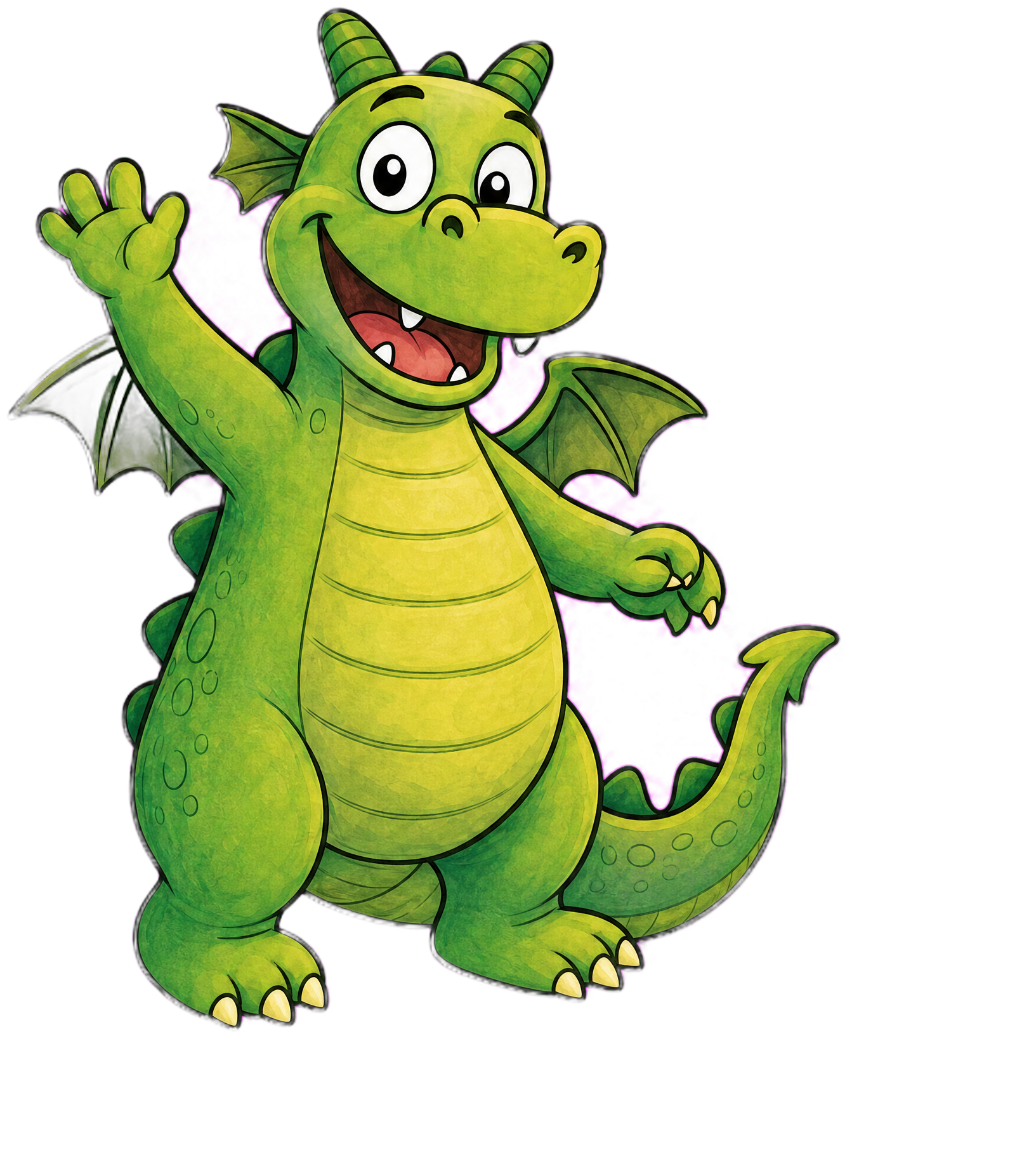
Kevin sketched the very first Spuki dragon himself – a rough but heartfelt drawing that captured the character’s soul: friendly, a little clumsy, and full of warmth. That original sketch remains the foundation of everything Spuki is today.
The final illustrations are created with the help of AI. Kevin is honest about this: his strength lies in storytelling, not in professional illustration. Combined with the time pressure of being a working father, AI allows him to bring his visions to life in the quality children deserve – without compromising on the stories themselves. Every narrative, every character, every value comes directly from Kevin’s heart and his life with Alexander.
The discovery: learning through fascination
Kevin observed how his son and many other children rediscover the world when they encounter the right motifs and stories. Children who previously seemed unfocused or disinterested suddenly became fascinated – they immersed themselves in the narrative, identified with the characters and absorbed values and knowledge quite naturally. Suddenly, it was no longer the diagnosis in the foreground, but the enthusiasm.
This observation aligns with research on narrative learning: when a child is excited about whether Spuki will make it up the mountain, something crucial happens in their mind: they learn – without realising it. Stories activate emotions, and what children feel, they remember. They transfer what they've experienced into their everyday life and become more independent step by step. Kevin calls this "learning through stories" – and it's in every Spuki book.
The mission: every child deserves to shine
What worked for his son should be accessible to all children. Kevin's goal: stories that meet every child where they are. That show: you are good just as you are. You can do this. And you're not alone.
With Spuki, Kevin has created a character that embodies exactly this: a little dragon who is sometimes insecure, who makes mistakes, but who always finds his own way. Children see themselves in Spuki – and through his adventures learn that they can master their everyday life when they believe in themselves and are there for each other.
"My son showed me that every child has their own way of learning. I want to accompany him so he becomes independent – so his strengths shine and his uniqueness fades into the background. Spuki is for all the children who need stories to discover the world."
3+
Books published
200+
Enthusiastic readers
Attention to detail
Also author of
Kevin Huber is also the author of the book Humanistic Education – a comprehensive guide to humanistic education that forms the pedagogical foundation of the Spuki universe.

Children's books for all learning paths – made for every child
Spuki books are clearly structured, visually strong and playfully educational – designed for children with different learning paths and perception styles. Inclusive children's books that appeal to all children, regardless of their abilities.
Every child perceives the world in their own way. Many children benefit from materials that are clearly structured, visually appealing and low-stimulus – regardless of whether they are neurodivergent or not.
Spuki books are designed for these diverse needs: every page follows a predictable layout with clear outlines, warm (non-overstimulating) colours and a manageable amount of text per page. The rhyming structure provides additional support and orientation.
What Spuki teaches children
Every story contains something that lasts. Through Spuki’s adventures, children learn what matters in life – without a wagging finger.
Values children can feel. Spuki acts with empathy, respect and responsibility in every story. Not because someone tells him to – but because that’s who he is. And children notice. Humanistic School Switzerland →
Being Happy
Spuki shows children that happiness lies in the small moments – in a smile, an adventure, a hug.
Being Strong
Being strong doesn’t mean doing everything alone. Spuki shows children they can do more than they think.
Being Brave
Courage doesn’t mean having no fear – but going ahead anyway. Spuki leads the way.
Giving Love
Compassion and warmth are the strongest forces. Spuki teaches children to see with the heart.
Sticking Together
Together we are stronger. Spuki’s adventures show how important friendship and solidarity are.
Being Curious
The world is full of wonders. Spuki awakens curiosity and the spirit of discovery in every child.
 "All of this is in my stories!"
Every book makes the world a little better
With every Spuki book sold, a portion of the proceeds goes as a donation to the Humanistic School Switzerland – for an education that sees and nurtures children as whole human beings.

Humanistic School Switzerland
The Humanistic School Switzerland is committed to ensuring that education is more than just knowledge transfer. It nurtures children holistically – on the cognitive, emotional and social level. Values such as empathy, courage, respect and self-confidence are at the centre.
With every Spuki book you buy, you directly support this vision. A portion of every sale goes as a donation to education projects that benefit children – regardless of their background or circumstances.
Donation per book
Education for all
Active across Switzerland
What others say about Spuki
Discover why families love Spuki. As we receive more genuine reviews, we’ll share them here.
"My children love Spuki! Every evening they want to hear a story. My son actually started being braver – without us having to teach him. It just came through the stories."
About: Spuki auf der Rigi
Sandra M.
Mum from Lucerne
"I’m impressed by how complex topics like empathy and self-confidence are presented in a child-friendly way. The children are captivated every time and always want to hear more."
About: Spuki im Ticino
Thomas K.
Dad from Zurich
"After reading aloud, my daughter always tells me what Spuki has learned. And then she says: ‘I’ll do that too now.’ A children’s book can’t work better than that."
About: Spuki auf der Rigi
Lisa W.
Reader from Bern
"The Spuki books are among my children’s favourites. The illustrations are beautiful and the stories are exactly the right length. They keep asking for new volumes!"
About: Spuki auf der Rigi – Colouring Book
Maria B.
Reader from Basel
"What convinced me: my son totally identifies with Spuki. The dragon is funny, sometimes insecure, but always warm-hearted. It gives my child the feeling that it’s okay not to be perfect."
About: Spuki auf der Rigi
Patrick R.
Dad from Zug
"We read the Spuki books regularly. The children are enthusiastic and afterwards we can talk wonderfully about the topics. Being happy, being brave – these are conversations children need."
About: Spuki im Ticino
Andrea S.
Mum from St. Gallen
Teile deine Erfahrung mit Spuki
Deine Rückmeldung hilft anderen Familien und inspiriert uns, Spukis Welt weiterzuentwickeln.
Ready for the first adventure?
Discover Spuki’s books and find the story that suits your child. Every book is a new step into a world full of courage, friendship and the joy of discovery.
All books also available as e-book · From CHF 7.– · Free shipping in Switzerland